
Every ecommerce blog seems to have the same shipping-savings checklist: switch to USPS regional rates, use FBA to skip zones, negotiate with your local carrier rep. None of it maps onto how shipping actually works north of the border. If you run a Canadian store and you’re wondering how to reduce shipping costs for ecommerce in Canada, you need tactics built around Canada Post, courier zone pricing, and cross-border customs. Not a rehash of American zone maps.
Why US Shipping Advice Doesn’t Work for Canadian Sellers
The US has a dense network of regional carriers, huge population centers close together, and fulfillment options on nearly every block. Canada has none of that. The country is geographically massive, but most of the population lives in a handful of urban corridors separated by thousands of kilometers.
That single fact breaks most US shipping advice. A tip like “use a regional carrier to skip zones” assumes you have five regional carriers to choose from. In Canada, many small businesses are stuck picking between Canada Post and a small set of national couriers. All of them price by distance.
The Real Cost of a Cross-Country Canadian Shipping Zone
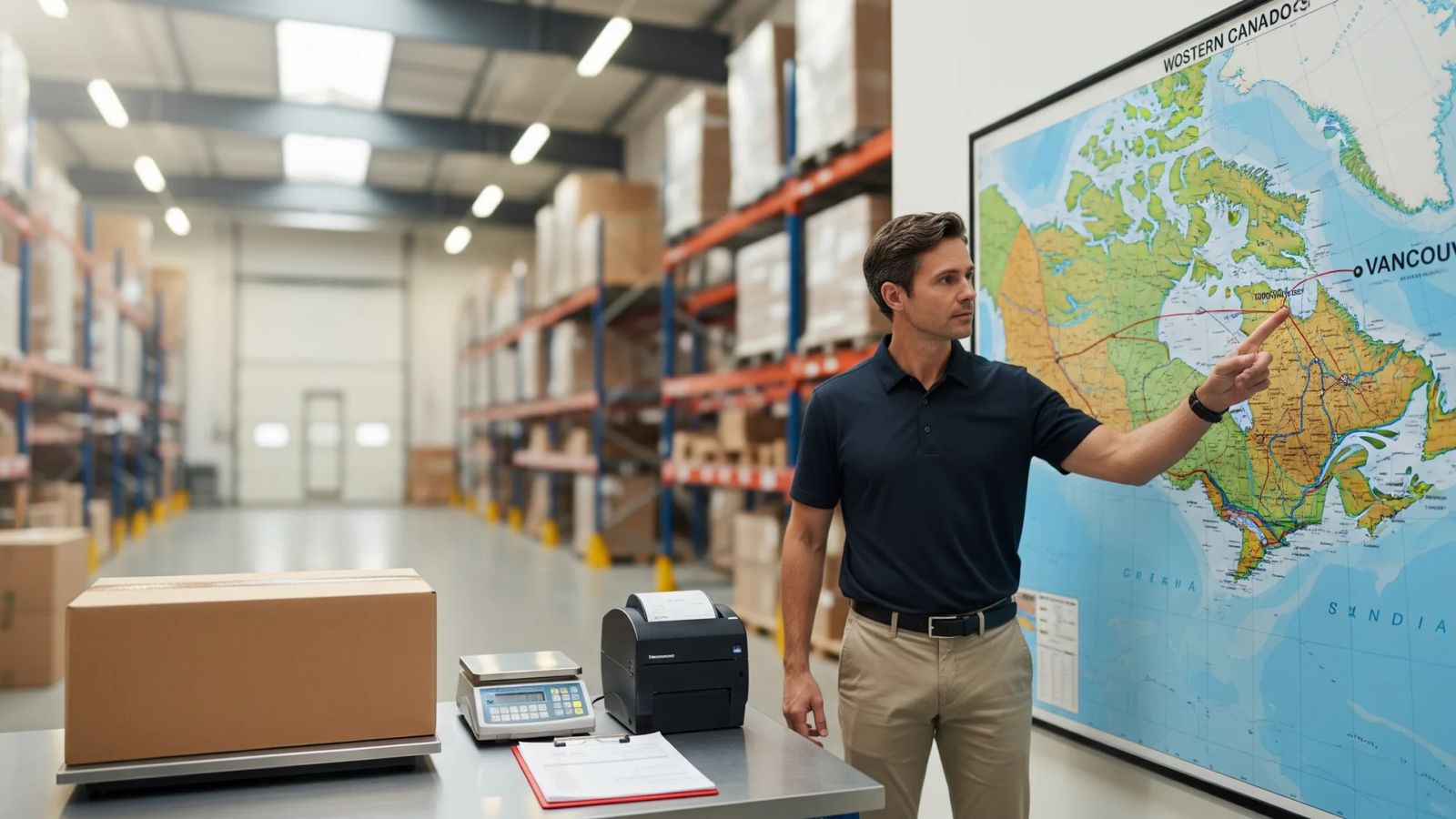
Picture a Toronto-based store shipping to a customer in Vancouver. That single package crosses almost the entire width of the country. Carriers price domestic parcels using distance-based zones. A package traveling coast-to-coast within Canada can cost multiple times more than one delivered within the same region.
If most of your orders come from Ontario and Quebec, this hurts a little. If your customer base is spread across BC, Alberta, and the Maritimes, it quietly eats a large chunk of your margin on every order. That’s the core reason cheap shipping for small business owners in Canada needs a different playbook than what works in the US.
Understand How Canadian Shipping Zones Actually Work
Canadian carriers, including Canada Post and the major courier networks, divide the country into pricing zones based on distance from the shipping origin. The farther a package travels, the more zones it crosses, and the higher the rate climbs.
This is straightforward when you ship from one warehouse and sell mostly to nearby provinces. It gets expensive fast when your single warehouse sits in Ontario but a large share of your orders ship west. Every one of those western orders gets billed at the most expensive zone tier, every single time.
What Zone Skipping Canada Actually Means
Zone skipping means bypassing the long-haul leg of a shipment by pre-positioning inventory closer to where your customers actually live. Instead of one package traveling the full distance from a central warehouse, the bulk shipment travels in bulk to a regional location. Then it ships the short “last leg” to the customer at local rates.
A small business shipping from a single Ontario warehouse to customers in BC often pays for the most expensive shipping zone on every western order. Splitting inventory across two regional warehouses can move many of those orders into a cheaper, closer zone instead. Over hundreds or thousands of orders a month, that shift adds up to a real, measurable drop in your average shipping cost.
Zone skipping is one of the biggest levers for lowering shipping costs in Canada, but it only works if you have warehouse space in more than one region. That’s exactly where working with a local fulfillment network changes the math, and it’s worth understanding what Canadian warehouse costs typically look like before you decide how many locations make sense for your volume.
Use a Local 3PL to Unlock Carrier Discounts Ecommerce Brands Can’t Get Alone
Carriers offer their best rates to shippers who move large volumes. A single small business, shipping a few hundred packages a month, has almost no leverage to negotiate a discount on its own. A third-party logistics provider does.
A 3PL combines the shipping volume of dozens or hundreds of merchants into one negotiating position. That pooled volume unlocks rate tiers usually reserved for large enterprise shippers, and every merchant using that 3PL benefits from them.
How Negotiated Carrier Rates Beat DIY Shipping Accounts
Merchants using a 3PL’s negotiated carrier accounts typically access rate tiers similar to those normally reserved for high-volume shippers, without having to commit to that volume themselves. You don’t need to hit a minimum package count or sign a long-term volume contract. You simply plug into rates the 3PL has already negotiated.
This is the fastest, lowest-effort way to get carrier discounts for ecommerce without spending months courting carrier account reps yourself. If you’re comparing your options, it’s worth looking at affordable 3PL options for small Canadian businesses to see how the numbers stack up against what you’re paying now.
Combined with zone skipping through regional warehouse placement, this is where the real, compounding savings in Canadian ecommerce shipping come from.
Practical Ways to Lower Shipping Costs Canada Merchants Can Implement This Year
Not every fix requires a new warehouse or a 3PL contract. Some savings come from tightening things you already control.
Packaging and Dimensional Weight Fixes
Carriers often charge based on dimensional weight, which factors in the size of a box, not just how much it weighs. An oversized box for a small, light product can cost more to ship than a properly sized one, even though the product inside weighs the same.
Audit your packaging sizes at least once a quarter. Look for products still shipping in boxes with excess empty space. Switching to a right-sized box or poly mailer, where appropriate, can shave real money off every shipment without touching your carrier contract at all.
Choosing the Right Carrier Mix
Few Canadian merchants stick to a single carrier once they look closely at their shipping data. Canada Post often wins on price for lighter, less time-sensitive parcels. Courier services can win on speed and reliability for heavier or time-critical orders.
Review your shipments by destination province and package weight. You may find that routing BC and Alberta orders through one carrier, while keeping Ontario and Quebec orders on another, lowers your blended average cost. Batching outbound shipments by region, rather than sending them out one at a time as orders come in, can also help you qualify for better per-package rates.
It’s also worth reviewing your return policy. Every returned package is a second shipping cost. Tightening sizing charts, product descriptions, and return windows reduces reverse-logistics spend without you having to touch a single carrier rate.
When to Bring in a Fulfillment Partner to Scale Without Overpaying
There’s a point where managing shipping yourself stops being cheaper and starts being a bottleneck. A few signals tell you it’s time to bring in a fulfillment partner.
Your order volume climbs month over month, but your shipping costs climb faster. You’re selling to customers in three or more provinces, and every western or Maritime order drags down your margin. You or your team spend hours each week manually printing labels, checking rates, and packing boxes instead of growing the business.
At that point, a Canadian 3PL isn’t an added expense. It’s how you scale fearlessly instead of overpaying for warehousing, labor, and freight you’re managing inefficiently on your own. Canadian Fulfill has spent over 10 years, through its parent operation EFS, helping Canadian merchants cut shipping and fulfillment costs by moving inventory closer to customers.
If you’re weighing the cost of outsourcing against staying in-house, a SMB pricing guide for order fulfillment companies can help you compare real numbers before you decide. When you’re ready to see what a local fulfillment partner could do for your shipping bill, Canadian Fulfill’s ecommerce fulfillment services are built specifically around zone-skipping and negotiated carrier rates for Canadian merchants.
Frequently Asked Questions About Reducing Ecommerce Shipping Costs in Canada
What is zone skipping and how does it reduce shipping costs for Canadian ecommerce stores?
Zone skipping means moving inventory closer to your customers ahead of time, instead of shipping every order the full distance from one central warehouse. It replaces an expensive, long-distance shipping leg with a cheaper, local one. That lowers your average cost per package, especially for orders headed to distant provinces.
Why don’t US-focused shipping cost tips work well for Canadian sellers?
Most US shipping advice assumes a dense network of regional carriers and warehouses close to major population centers. Canada’s population is spread across a much larger geography with fewer carrier options. Pricing structures, zone maps, and fulfillment strategies built for the US don’t translate directly.
How can a small business get carrier discounts without shipping high volume on its own?
Partnering with a 3PL lets you access negotiated carrier rates built on pooled volume from many merchants. You get pricing similar to what a high-volume shipper pays, without needing to hit any volume minimum yourself.
What is the cheapest way to ship packages for a small business in Canada?
There isn’t one single cheapest option. It depends on the weight, size, and destination of your packages. Right-sizing your packaging, matching each shipment to the carrier that prices it best, and skipping expensive long-haul zones through regional warehousing together bring down your overall cost more than any single carrier switch.
Does using a 3PL actually save money compared to shipping in-house?
For most growing merchants, yes. In-house shipping means paying retail or lightly discounted carrier rates, managing packaging waste, and covering warehouse space yourself. A 3PL spreads those costs across many merchants and negotiates rates you likely can’t get alone. That usually means a lower landed shipping cost per order.
How do Canadian shipping zones affect the cost of delivering to provinces like BC or Alberta?
If your warehouse sits in Ontario or Quebec, orders to BC or Alberta cross more zones and cost more per package than local orders. Pre-positioning inventory in a western warehouse, or working with a 3PL that already has one, moves those orders into a cheaper zone tier and narrows the cost gap between your eastern and western customers.
Shipping costs in Canada don’t have to keep climbing as you scale. A quote from Canadian Fulfill will show you exactly how much you could save by combining zone skipping with negotiated carrier rates, at no cost or obligation.
Add a Comment