Amazon FBA Prep Requirements in Canada – The Complete Guide
Selling on Amazon is one of the fastest ways to grow an eCommerce business, but success starts long before your products reach Amazon’s fulfillment centers.
Whether you’re importing products from overseas or manufacturing them locally, every shipment must meet Amazon’s strict preparation requirements before it can be received into inventory.
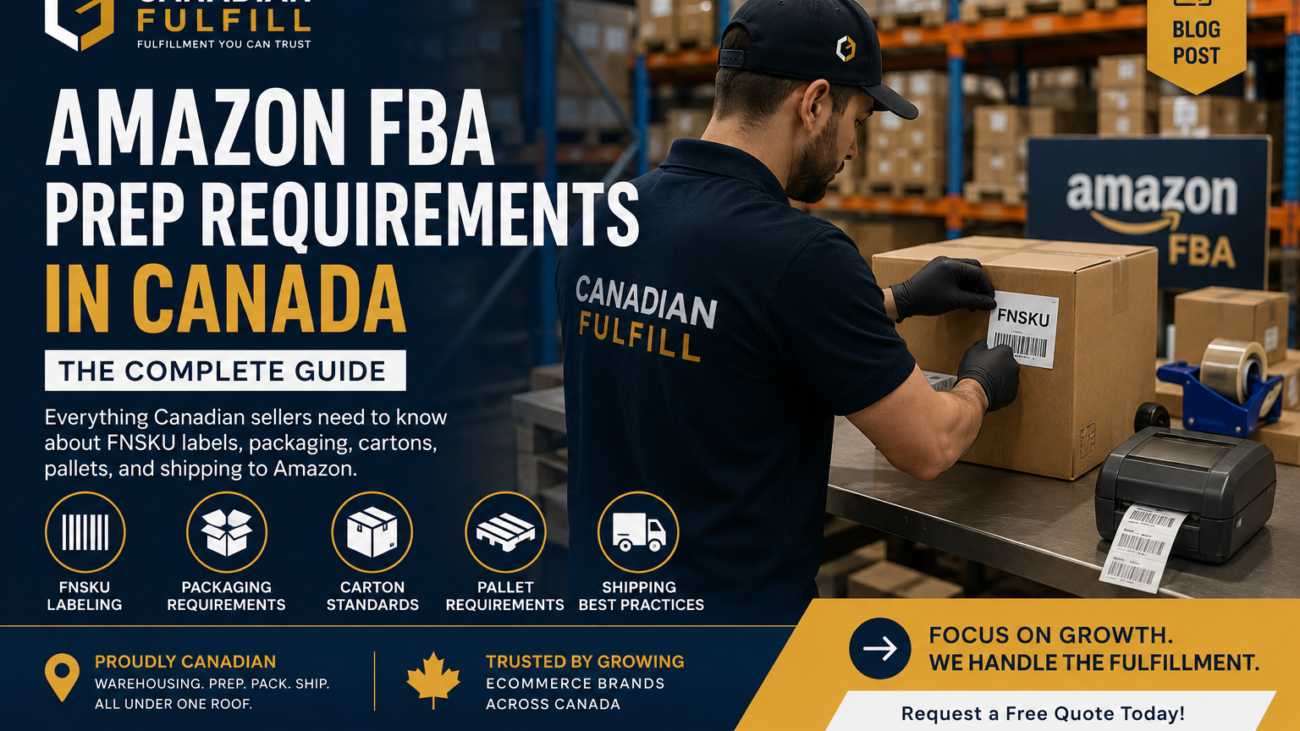
In this guide, we’ll explain everything Canadian sellers need to know about Amazon FBA preparation, labeling, packaging, pallet requirements, and how working with a professional prep center can save time and reduce costly mistakes.
Amazon FBA (Fulfillment by Amazon) allows businesses to store inventory inside Amazon fulfillment centres. Amazon then handles storage, order fulfillment, customer service, returns, and shipping.
Instead of shipping every order yourself, you send inventory in bulk to Amazon. When a customer places an order, Amazon picks, packs, and ships the product.
This allows sellers to focus on sourcing products, marketing, and growing their business instead of managing daily logistics.
Why Amazon FBA Prep Matters
Before inventory reaches an Amazon fulfillment centre, every product must comply with Amazon’s preparation standards.
Improperly prepared shipments can result in:
Receiving delays
Additional Amazon prep fees
Inventory being rejected
Customer complaints
Damaged products
Lost Buy Box opportunities
A professional Amazon prep process helps ensure products arrive ready for immediate sale while minimizing delays and additional costs.
Amazon FBA Preparation Requirements
Although preparation requirements vary depending on the product category, most inventory follows these general standards.
Product Inspection
Check for damaged packaging
Verify product quantity
Confirm product variations
Inspect barcodes
Ensure products are clean and saleable
Product Protection
Poly bagging when required
Bubble wrapping fragile items
Shrink wrapping multipacks
Applying suffocation warnings where necessary
Securing loose components
Label Verification
Amazon barcode visible
Manufacturer barcode covered if required
Correct marketplace selected
Product matches listing
Amazon FNSKU Labels Explained
Every product sent to Amazon FBA generally requires an Amazon FNSKU barcode unless you are using specific manufacturer barcode programs.
The FNSKU uniquely identifies your inventory and ensures that every unit sold belongs to your seller account.
Requirement
Status
Readable barcode
Required
Correct SKU
Required
Proper placement
Required
Manufacturer barcode covered (when applicable)
Required
Professional prep centres verify every barcode before inventory is shipped to Amazon, reducing the risk of receiving issues.
Packaging Requirements
Products must be packaged to withstand transportation and warehouse handling. Packaging requirements vary by product type, but common preparation includes:
Poly bags for loose products
Bubble wrap for fragile items
Boxing sets together
Protective inserts
Tamper-resistant seals when required
Expiration labels for applicable products
Choosing the right packaging helps reduce damage during transportation and improves the customer experience when orders are fulfilled.
Selling on Amazon Canada offers many advantages, no matter where your business is based. Below, we highlight some of the top benefits of expanding into this marketplace to show you how this move can take your brand to new heights.
1) More opportunities
Amazon.ca garners a noteworthy 15.9 million unique visitors each month. This provides a new opportunity to showcase your products to a fresh market of buyers. Plus, with a lower number of sellers than Amazon.com, you have a higher chance of gaining more listing views and conversions.
Amazon Canada is also showing signs of rapid growth in the market, which makes jumping in early all the more important. With a smaller market size (and therefore less competition within Canada), this is a unique opportunity to grow your brand.
2) Diversify your revenue streams
One of the obvious benefits of expanding your sales to Canada is that it diversifies your revenue streams, but with less risk since you stay on the North American continent rather than going overseas.
Additionally, Canadians share many of the same consumer needs and interests as their southern neighbors, so it’s easier to break into their market.
The significant market and cultural overlap between Canada and the U.S. simplifies marketing and advertising efforts in Canada since you can employ many of the same methods you do at home. In addition, geographic proximity is a major bonus, as it reduces delivery times and saves on fulfillment costs.
3) Increase revenue
Tapping into a new market all but guarantees more revenue for your business. Also, if you use the North American Remote Fulfillment (NARF) program, you already have an idea of your demand in the Canadian market.
By transitioning to Canadian FBA, you can reduce your business expenses and increase listing conversions.
4) Optimize ad spend
We have noticed sellers who use NARF alone see lower conversion rates when advertising in Canada and Mexico. This results in a higher advertising cost of sales (ACOS) and a lower return on advertising spend (ROAS).
By selling on Amazon.ca and having inventory within Canada, you can help boost your ROAS thanks to domestic inventory that’s eligible for Prime-speed shipping. This helps your ad dollars go further while also boosting your customer experience.
5) Open inventory limits
Amazon U.S. and Amazon Canada have separate, unrelated FBA inventory limits. Therefore, expanding to Canada allows you to have more inventory on hand that’s ready to sell. You can also optimize inventory allocation in each region independent of one another.
6) Greater brand valuation
Establishing and growing an international presence will boost your brand’s value in the long term.
One of the factors that Amazon aggregators should consider when buying a brand is expansion opportunities. Having an international footprint shows that a brand does well across different markets and has a flexible supply chain.
Expanding to Canada and beyond will help your brand become a global name, and thus drive more sales from multiple markets.
7) Less competition
Depending on your niche, you may have few competitors in Canada, or the competition may fail to take full advantage of the Canadian market.
For those competitors who are already in Canada and enjoy a market share, use their presence to your advantage: You can analyze their success to gauge how high demand is for your niche. Then you can begin to carve out your own market share by introducing your products so Canadians have greater choice.
How to launch your store on Amazon Canada
If you’re on the southern side of the border, it may seem daunting to get started in Canada. Below, we outline some simple steps to make the process as seamless as possible.
1) Establish your business
As an international seller, you can make your life significantly easier by creating an Amazon North American Unified account. This account allows you to switch smoothly between amazon.com, amazon.ca, and amazon.mx in the seller central. This will simplify your processes for listing products and managing orders in each country.
A Unified account lets you do the following in each North American market:
Share listing info and manage inventory
Track orders
Access tools
Manage single monthly subscriptions
Accept local currency payments
You should also consider hiring an Amazon Canada consultant to ensure your northward expansion goes smoothly. Amazon Canada consultants and agencies are experts in selling and marketing in Canada and have the best tools and tricks to help you establish your business in this market.
2) Canadian taxes
When you sell products in Canada, you’re responsible for paying taxes, duties, and customs clearance fees when applicable. This includes federal and provincial sales taxes, which vary for each province and territory (as outlined in the table below).
Provincial and territorial tax rates in Canada
Make sure you understand the non-resident importer (NRI) requirements as well. These are legal requirements for sellers located outside of Canada who import goods for sale in the country.
The first importer requirement you should obtain (and one of the most significant) is a business number from the Canada Revenue Agency.
This is what allows you to operate as a business within Canada. Without it, you risk being shut down and fined, and you may lose out on the inventory and processes you’ve already set up in the country.
3) Inventory management
To simplify inventory management, make sure you use the right SKUs for your needs.
You should employ a global SKU if you ship your own orders to a variety of countries. Use marketplace-specific SKUs if you have distinct inventory pools in each country.
4) Importing inventory to Canada
Importing inventory to Canada from the U.S. can be costly since you have to pay customs for inbound transportation to the U.S., then pay Canadian customs when you export to Canada. To cut down on expenses, see if you can ship your products directly to Amazon FBA fulfillment centers in Canada from your own warehouse in the U.S. or China. This will help you avoid an assortment of intermediate shipping fees.
However, you can only ship to an FBA center if you meet all FBA labeling compliances. This may cause difficulties if you don’t have a Canadian return address in case the shipment is rejected. A workaround for this is either to establish a Canadian address by leasing space or use a Canadian fulfillment partner’s address.
5) Fulfillment and returns
Fulfillment
As mentioned previously, you can ship inventory directly to FBA fulfillment centers in Canada. If you opt for this route, it’s helpful to use a Canadian third-party logistics (3PL) partner to receive your inventory and forward it to these centers. When you first get started in Canada, you’ll have small inventory limits, so it’s best to use a 3PL to drip-feed inventory to Amazon.
3PLs within Canada can handle FBM there if you prefer having more control over your fulfillment processes.
Returns
Returns from Canadian customers will need to be routed to a Canadian address. If you partner with a Canadian Amazon 3PL, they’ll be able to receive and process returns for you. If not, you’ll need a Canadian address such as a warehouse leased directly or with a partner.
6) Advertising in Canada
Another area that has far less competition in Canada than the American market is advertising. Fortunately, setting up your Amazon Canada ads is simple, since all ad placements are the same in the Canadian market.
It’s worth noting that ROAS is generally higher in Canada, and CPC is lower than it is in the U.S. Despite the similarities though, Canadians are fundamentally a different breed of customer than their American counterparts. Make sure your marketing efforts reflect this by taking into consideration their differences in culture, tastes, and values.
An important example is your use of spelling differences, such as “color” versus “colour” and “gray” versus “grey.” Implementing American spelling will mark you as foreign and may annoy potential customers. Consider hiring a local agency to help optimize your advertisements for the Canadian market.
Canada’s larger variance in weather is another important factor to keep in mind, as it impacts product and advertising needs. For example, unlike countries with mild climates, many parts of Canada see cold snowy winters. That means it’s not the time to advertise light jackets or patio furniture.